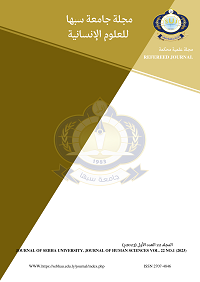
The possible worlds. Hermeneutics of the Different hadith of Ibn Qutayba.
DOI:
https://doi.org/10.51984/johs.v22i1.2486Keywords:
Ibn Qutayba, Possible worlds, Semantic Analysis, Logical Semantics, Logic Of Destination, PragmaticsAbstract
Possible worlds are among the terms that appeared in logical semantics, and the scholars’ interest in this term was related to their talk about the conditions for the veracity of sentences, and about describing sentences containing elements whose veracity cannot be verified in some worlds, or the nature of these worlds differs from the nature of known worlds.
Looking at the Arab heritage, we note that some scholars dealt with the possible and the impossible from the semantic point of view, specifically Ibn Qutayba in the field of analyzing the Prophet's discourse, as his treatment of the problem of the concept of truth and lies was based on the concept of the multiplicity of worlds (possible worlds). His vision came in the context of responding to those who deny some phenomena that are not possible in the real world. Rather, the proponents of this vision deny, in the first place, the legitimacy of asserting the existence of a world separate from human experiences that language describes; Because the dominant paradigm from the social point of view of man's position and his environment turns into the concept of "the real world As opposed to other worlds that differ from this model and intersect with it. Ibn Qutayba noticed that some knowledge cannot be comprehended rationally if it is measured on the living world, and in order for us to understand and visualize it, we must visualize other worlds that are different from us and what we have spent in our lives. And he said: “And the people of denial did not bring this and its like, except by referring them to what is absent from them, to what is present with them, and making them do things according to what they know from themselves.”
This research will answer a fundamental question, which is: How did Muslim scholars deal with the contradictions of discourse (language) with the world?, which will raise some other questions that we intend to answer in the folds of the research.
Ibn Qutbah took the concept of the multiplicity of worlds, a procedural approach, in the semantic analysis of the Prophet's hadith, and access to the significance of his speech. Therefore, in this paper, we will seek to demonstrate Ibn Qutayba's approach to the concept of the multiplicity of worlds (possible worlds) within the interpretation of the problem from the hadith of the Prophet, by means of a descriptive and analytical approach to explain and analyze the phenomenon.
Downloads
Downloads
Published
Issue
Section
License
Journal of Humanities Policy on Intellectual Property and Plagiarism
1. Commitment to Intellectual Property and Ethics
The Journal of Humanities (JOHS) is fully committed to respecting intellectual property rights and aims to protect the originality and authentic work of authors who submit their manuscripts for publication. The journal takes a firm stand against articles that contain any form of plagiarism and emphasizes the need for all researchers to adhere to the highest ethical standards in scientific research.
2. Anti-Plagiarism Policy
The journal considers plagiarism a serious violation of academic ethics. Therefore, authors must ensure that their work is original and not plagiarized, and that any use of external sources is properly cited and documented according to correct academic standards.
-
Actions Taken: In the event that any plagiarism or academic theft is discovered in a submitted article, the editorial board will contact the author to request a formal explanation within a maximum period of two weeks from the date of notification.
-
Investigation and Decision: After receiving the explanation, the article will be referred to the journal's specialized committees, which will investigate the matter and take the necessary measures, which may include the permanent rejection of the article and the imposition of disciplinary actions.
3. Publication License and Author Rights
The journal adopts the Creative Commons license type Attribution-NonCommercial-NoDerivs 4.0 International (CC BY-NC-ND 4.0), which allows for the following:
-
Attribution: Users are entitled to cite the content published in the journal and use it in their work, provided that the original source and author are clearly credited.
-
Non-Commercial: The published content may not be used for any commercial purpose.
-
NoDerivs: It is not permitted to make any modifications, distortions, or to build derivative works from the published content.
Under this license, authors are required to complete an exclusive license agreement for the journal. Authors retain the rights to their research data and may reuse and share their work for scientific purposes with proper citation.