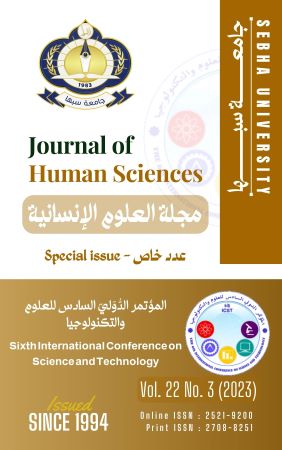
Enseigner/Apprendre le français langue étrangère Etude de cas : Professeurs de français à Benghazi
DOI:
https://doi.org/10.51984/johs.v22i4.2964Keywords:
Formations, Pixel, Enseignants, RéintroductionAbstract
Le français est une langue optionnelle en Libye, elle n’intervient qu’à l’université et n’attire par la suite que peu d’étudiants. En 1968 le ministère de l'Éducation a procédé à des reformes au niveau des langues étrangères et a supprimé les langues étrangères des cursus ; universitaire et scolaire Passant par plusieurs autres étapes, récemment, on se trouve face à la réintroduction de l'enseignement du français aux écoles secondaires.
A la recherche d’un moyen d’améliorer l’enseignement, et d’un moyen d’attirer les étudiants, le ministère adopté à une nouvelle méthode réalisé par le corps professoral des universités libyennes avec la coopération de celui français d’où la réalisation du kit nommé Pixel relégué aux 27 formateurs libyens qui ont entrepris une formation à Besançon en 2019. Comment enseigner autrement cette langue, comment initier une pratique vivante de la langue et obtenir des apprentissages durables ? Tel était le but de Pixel
Nous aspirons par notre contribution à donner un aperçu de ce que nous avons pu réaliser, en tant que formatrice, lors de cette formation. Histoire de donner un état de lieu de ce qui s’est entrepris durant cette formation, avec une vision un peu plus détaillée du kit Pixel utilisé dans le processus de la formation des futurs professeurs libyens. Une expérience inédite ; les participants ont su s’approprier cette nouvelle pédagogie, ont pu saisir cette occasion pour concrétiser leurs apprentissages, ont assumé le travail en équipe, ont été à la hauteur d’apprendre en agissant et ont su par la suite réinvestir leurs compétences langagières.
Downloads
Downloads
Published
Issue
Section
Categories
License
Journal of Humanities Policy on Intellectual Property and Plagiarism
1. Commitment to Intellectual Property and Ethics
The Journal of Humanities (JOHS) is fully committed to respecting intellectual property rights and aims to protect the originality and authentic work of authors who submit their manuscripts for publication. The journal takes a firm stand against articles that contain any form of plagiarism and emphasizes the need for all researchers to adhere to the highest ethical standards in scientific research.
2. Anti-Plagiarism Policy
The journal considers plagiarism a serious violation of academic ethics. Therefore, authors must ensure that their work is original and not plagiarized, and that any use of external sources is properly cited and documented according to correct academic standards.
-
Actions Taken: In the event that any plagiarism or academic theft is discovered in a submitted article, the editorial board will contact the author to request a formal explanation within a maximum period of two weeks from the date of notification.
-
Investigation and Decision: After receiving the explanation, the article will be referred to the journal's specialized committees, which will investigate the matter and take the necessary measures, which may include the permanent rejection of the article and the imposition of disciplinary actions.
3. Publication License and Author Rights
The journal adopts the Creative Commons license type Attribution-NonCommercial-NoDerivs 4.0 International (CC BY-NC-ND 4.0), which allows for the following:
-
Attribution: Users are entitled to cite the content published in the journal and use it in their work, provided that the original source and author are clearly credited.
-
Non-Commercial: The published content may not be used for any commercial purpose.
-
NoDerivs: It is not permitted to make any modifications, distortions, or to build derivative works from the published content.
Under this license, authors are required to complete an exclusive license agreement for the journal. Authors retain the rights to their research data and may reuse and share their work for scientific purposes with proper citation.