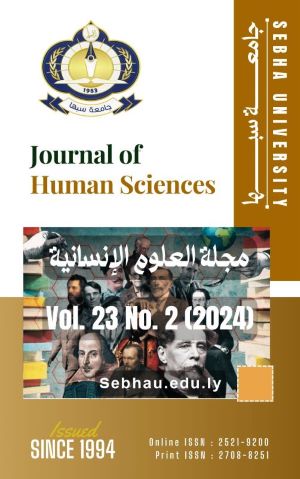
Spatial Analysis of bakeries in Sebha city using Gis – in the services geography.
DOI:
https://doi.org/10.51984/johs.v23i2.3444Keywords:
Spatial analysis, Bakeries , Planning standards, Gegraphy serrices, GisAbstract
Spatal and lysis of bakeries in the city of sebbausing geographic in formation sgstems.Astady in the geograbhy phy of serries summary, This researchaims to know the patterns of gegraphical. Distribution of bakeries in the city of sebuha .The reality of othe spatial distribution of these bakeries .Therough the use of geogra phical in formation systms (GIS). And an explanation of the current distribution paftern ofbakeries and it is realation ship to some geographical variablas. The research relied on the descriptive and analytical approah in addition to the use of geographic formation systems te chnology. Suchas naalyzing The standad distanca.The average center.The average parameter .The nieghbor hood connention, and The moran coefficient,to determine The mostimportant bakeries and The extent of ,problems facing compliance with planning standards for bakeries for residents of The city of sebha The research shoued that approximately haif. Bakries are concent rafed in the localities of ALManshiya and ALQardah,equiralent to 41.2% of the total number of bakeries in the city of sebha. It was also shown that the geogrephical distribution of bakeries takesa clustered pattern tending toa regular patten according to The nearest neighbor analysis,and the distribution of the phenomenon trends from The north west to The sontheast according to The analysis of The direction of distribution and that the middle center Is located in the centero of The city.(lqaid), and The middle landmark of The phenomenon is located or bakeries, wich reprsent The AL-Alam bakery in The Loca lity of AL-Qarada It also takes The scattered patternwhen andlyzing moran. Thus,we find that through spatial analyzes it indicates The regularity of the distribution of bakeries and that they are clustered in places and not present in places
Downloads
Downloads
Published
License
Journal of Humanities Policy on Intellectual Property and Plagiarism
1. Commitment to Intellectual Property and Ethics
The Journal of Humanities (JOHS) is fully committed to respecting intellectual property rights and aims to protect the originality and authentic work of authors who submit their manuscripts for publication. The journal takes a firm stand against articles that contain any form of plagiarism and emphasizes the need for all researchers to adhere to the highest ethical standards in scientific research.
2. Anti-Plagiarism Policy
The journal considers plagiarism a serious violation of academic ethics. Therefore, authors must ensure that their work is original and not plagiarized, and that any use of external sources is properly cited and documented according to correct academic standards.
-
Actions Taken: In the event that any plagiarism or academic theft is discovered in a submitted article, the editorial board will contact the author to request a formal explanation within a maximum period of two weeks from the date of notification.
-
Investigation and Decision: After receiving the explanation, the article will be referred to the journal's specialized committees, which will investigate the matter and take the necessary measures, which may include the permanent rejection of the article and the imposition of disciplinary actions.
3. Publication License and Author Rights
The journal adopts the Creative Commons license type Attribution-NonCommercial-NoDerivs 4.0 International (CC BY-NC-ND 4.0), which allows for the following:
-
Attribution: Users are entitled to cite the content published in the journal and use it in their work, provided that the original source and author are clearly credited.
-
Non-Commercial: The published content may not be used for any commercial purpose.
-
NoDerivs: It is not permitted to make any modifications, distortions, or to build derivative works from the published content.
Under this license, authors are required to complete an exclusive license agreement for the journal. Authors retain the rights to their research data and may reuse and share their work for scientific purposes with proper citation.