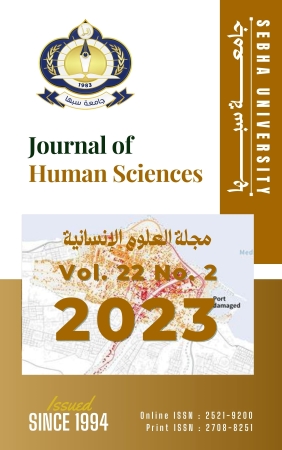
Flash Flood Hazards Management in Ghat Area (SW Libya) Using Spatial Techniques
DOI:
https://doi.org/10.51984/johs.v22i2.2664Keywords:
Flash Flood Hazards, Remote Sensing, GIS, Digital Elevation Model (SRTM), Ghat AreaAbstract
Ghat town and some of its neighbouring areas are exposed to occasional torrential rains, but they may be dangerous and destructive in rare cases, as happened in June 2019. The study aims to propose solutions to protect Ghat and its surroundings from flood hazards in the future. Remote sensing (RS) and geographic information systems (GIS) were used to achieve this goal. Therefore, a satellite image taken from the European satellite (Sentinel 2) was relied upon to determine the areas that were subject to floods, and the paths of the wadies that swept the region at the beginning of June 2019. The digital elevation model (SRTM1) was also relied upon to conduct morphometric analyses and extract drainage networks for the wadies affecting Ghat and the surrounding areas, in addition to determining the best suitable places for the establishment of the proposed facilities.
The study discussed the possible alternatives to avoid flood hazards in the region, and recommended the construction of three dams on the three most important wadies that affect Ghat town and its surroundings, provided that the priority in implementation is consistent with the order of their inclusion in the study.
Downloads
Downloads
Published
Issue
Section
License
Journal of Humanities Policy on Intellectual Property and Plagiarism
1. Commitment to Intellectual Property and Ethics
The Journal of Humanities (JOHS) is fully committed to respecting intellectual property rights and aims to protect the originality and authentic work of authors who submit their manuscripts for publication. The journal takes a firm stand against articles that contain any form of plagiarism and emphasizes the need for all researchers to adhere to the highest ethical standards in scientific research.
2. Anti-Plagiarism Policy
The journal considers plagiarism a serious violation of academic ethics. Therefore, authors must ensure that their work is original and not plagiarized, and that any use of external sources is properly cited and documented according to correct academic standards.
-
Actions Taken: In the event that any plagiarism or academic theft is discovered in a submitted article, the editorial board will contact the author to request a formal explanation within a maximum period of two weeks from the date of notification.
-
Investigation and Decision: After receiving the explanation, the article will be referred to the journal's specialized committees, which will investigate the matter and take the necessary measures, which may include the permanent rejection of the article and the imposition of disciplinary actions.
3. Publication License and Author Rights
The journal adopts the Creative Commons license type Attribution-NonCommercial-NoDerivs 4.0 International (CC BY-NC-ND 4.0), which allows for the following:
-
Attribution: Users are entitled to cite the content published in the journal and use it in their work, provided that the original source and author are clearly credited.
-
Non-Commercial: The published content may not be used for any commercial purpose.
-
NoDerivs: It is not permitted to make any modifications, distortions, or to build derivative works from the published content.
Under this license, authors are required to complete an exclusive license agreement for the journal. Authors retain the rights to their research data and may reuse and share their work for scientific purposes with proper citation.