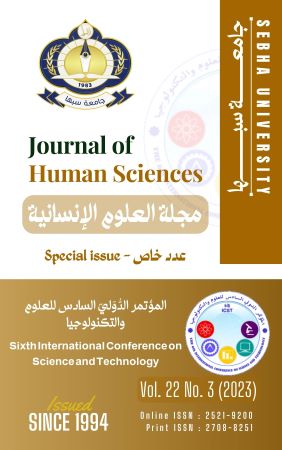
Erreurs et intégration des TICE en classe de FLE
DOI:
https://doi.org/10.51984/johs.v22i4.2917Keywords:
Erreurs, Langue maternelle, Langue étrangère, Intégration, EnseignementAbstract
Apprendre une langue étrangère n’est assurément pas facile pour des locuteurs possédant une langue éloignée de la Langue cible; à cela s’ajoutent les écarts culturels entre un champ linguistique et un autre. C’est le cas de nos apprenants libyens ayant l’arabe comme langue maternelle et leur propre culture. En fait, « Dans tout discours en langue maternelle ou en langue étrangère, à l’oral ou à l’écrit, peuvent apparaître toutes sortes d’erreurs », Aldjia Outaleb-Pellé, (2010 : 39). Ces erreurs font parfois partie intégrante de l’apprentissage et témoignent de la progression en classe vers une meilleure intelligence de la langue étudiée, la langue française. La question de l’erreur se trouve au cœur de la problématique de l’enseignement / apprentissage du FLE. C’est pourquoi elle mérite que nous nous intéressions de façon approfondie dans quel contexte elle se situe. Il est sans doute envisageable de cerner des erreurs et de proposer des procédures afin d’éviter celles-ci en procédant à des investigations propres à un contexte particulier. Nous comptons dans cette étude, proposer des pistes didactiques concrètes susceptibles de permettre une remédiation des erreurs assimilable par les apprenants libyens. Une réflexion sera amenée, dans cette partie du travail, sur deux objectifs essentiels : l’enseignement de la langue et les possibilités d’amélioration des démarches d’enseignement utilisées. Nous allons essayer de donner quelques procédures inscrites dans une pratique pédagogique dans une classe de français langue étrangère dans les départements universitaires du français en Libye.
Downloads
Downloads
Published
Issue
Section
Categories
License
Journal of Humanities Policy on Intellectual Property and Plagiarism
1. Commitment to Intellectual Property and Ethics
The Journal of Humanities (JOHS) is fully committed to respecting intellectual property rights and aims to protect the originality and authentic work of authors who submit their manuscripts for publication. The journal takes a firm stand against articles that contain any form of plagiarism and emphasizes the need for all researchers to adhere to the highest ethical standards in scientific research.
2. Anti-Plagiarism Policy
The journal considers plagiarism a serious violation of academic ethics. Therefore, authors must ensure that their work is original and not plagiarized, and that any use of external sources is properly cited and documented according to correct academic standards.
-
Actions Taken: In the event that any plagiarism or academic theft is discovered in a submitted article, the editorial board will contact the author to request a formal explanation within a maximum period of two weeks from the date of notification.
-
Investigation and Decision: After receiving the explanation, the article will be referred to the journal's specialized committees, which will investigate the matter and take the necessary measures, which may include the permanent rejection of the article and the imposition of disciplinary actions.
3. Publication License and Author Rights
The journal adopts the Creative Commons license type Attribution-NonCommercial-NoDerivs 4.0 International (CC BY-NC-ND 4.0), which allows for the following:
-
Attribution: Users are entitled to cite the content published in the journal and use it in their work, provided that the original source and author are clearly credited.
-
Non-Commercial: The published content may not be used for any commercial purpose.
-
NoDerivs: It is not permitted to make any modifications, distortions, or to build derivative works from the published content.
Under this license, authors are required to complete an exclusive license agreement for the journal. Authors retain the rights to their research data and may reuse and share their work for scientific purposes with proper citation.