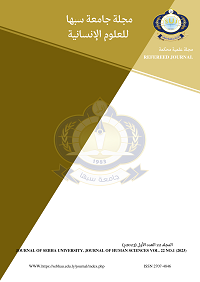
The Ambition Among Students In The Light Of Some Social Variables
DOI:
https://doi.org/10.51984/johs.v22i1.2458Keywords:
Ambition, Career, Education, Social, VariablesAbstract
This research proceeds to achieve a set of goals, including knowing the professional ambition that most of the preparatory education students seek, and identifying the reasons that prompted to draw the features of this ambition, and this study was launched to verify a set of hypotheses, which is the existence of a statistically significant relationship between professional ambition and a set of variables, namely (gender / income / profession of father and mother / level of education of father and mother / student estimate), and the approach used in this study was the survey by sample. Its type was a relative stratified random sample, consisting of 253 items distributed over 6 schools from the city of Ajdabiya, in which the interview form was used, It was fixed with a degree of 0.93 through the use of the Alfacronbach test coefficient and a valid one with a rate of 0.96. With the following variables: (mother and father's occupation - income - mother's level of education) according to the results of the chi-square test. fertile and worthy of scrutiny and scientific scrutiny, and the competent authorities must link between what students aspire to and plans for educational and economic development.
Downloads
Downloads
Published
Issue
Section
License
Journal of Humanities Policy on Intellectual Property and Plagiarism
1. Commitment to Intellectual Property and Ethics
The Journal of Humanities (JOHS) is fully committed to respecting intellectual property rights and aims to protect the originality and authentic work of authors who submit their manuscripts for publication. The journal takes a firm stand against articles that contain any form of plagiarism and emphasizes the need for all researchers to adhere to the highest ethical standards in scientific research.
2. Anti-Plagiarism Policy
The journal considers plagiarism a serious violation of academic ethics. Therefore, authors must ensure that their work is original and not plagiarized, and that any use of external sources is properly cited and documented according to correct academic standards.
-
Actions Taken: In the event that any plagiarism or academic theft is discovered in a submitted article, the editorial board will contact the author to request a formal explanation within a maximum period of two weeks from the date of notification.
-
Investigation and Decision: After receiving the explanation, the article will be referred to the journal's specialized committees, which will investigate the matter and take the necessary measures, which may include the permanent rejection of the article and the imposition of disciplinary actions.
3. Publication License and Author Rights
The journal adopts the Creative Commons license type Attribution-NonCommercial-NoDerivs 4.0 International (CC BY-NC-ND 4.0), which allows for the following:
-
Attribution: Users are entitled to cite the content published in the journal and use it in their work, provided that the original source and author are clearly credited.
-
Non-Commercial: The published content may not be used for any commercial purpose.
-
NoDerivs: It is not permitted to make any modifications, distortions, or to build derivative works from the published content.
Under this license, authors are required to complete an exclusive license agreement for the journal. Authors retain the rights to their research data and may reuse and share their work for scientific purposes with proper citation.