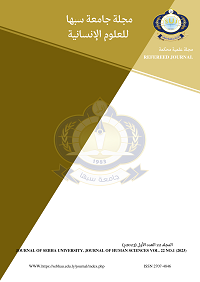
The Libyan press and its role in the growth of national sentiment and its exposure of Italian ambitions in Libya 1910 - 1911 AD
DOI:
https://doi.org/10.51984/johs.v22i1.2484Keywords:
Ottoman, French ambitions, Libyan, Italian, PressAbstract
In this research, we discuss the media campaign that Libya witnessed at the end of the second Ottoman era by the Libyan newspapers and the media campaign that they adopted in order to educate the Libyans about the dangers facing their country represented in the Italian ambitions, and the policy of peaceful penetration followed by the Italian government, and this campaign included all the different groups of the people Whether in the cities, among the educated or the workers, or among the tribesmen and the heads of the Sufi orders in the interior.
The Libyan newspapers exposed Italian ambitions in Libya (1910 - 1911 AD), published all its plans on their pages, and alerted the Libyans to the means used by the Italian government in order to implement its colonial plans in the country. It also took upon itself to publish articles published in Italian newspapers after Translated and republished in Arabic, in order for the Libyans to know what the Italians are planning in secret against their country. The Libyan press played a major role in raising awareness and awakening the national spirit and a sense of responsibility among a large number of Libyans, and their dignitaries, whose image became clear through the role played by Libya’s representatives in The Council of Envoys in the Ottoman capital, which was represented in their follow-up to the media campaign led by the Libyan newspapers and what they published on their pages against the Italian danger threatening the country, and their follow-up also to the popular demands in the central government departments in Istanbul.
The press also succeeded in its awareness campaign about the dangers of Italian colonial penetration, and this was reflected in the people’s demonstrations of telegraphic protest to the Ottoman Sultan and objecting to the Ottoman appeasement policy towards the expected Italian danger.
Downloads
Downloads
Published
Issue
Section
License
Journal of Humanities Policy on Intellectual Property and Plagiarism
1. Commitment to Intellectual Property and Ethics
The Journal of Humanities (JOHS) is fully committed to respecting intellectual property rights and aims to protect the originality and authentic work of authors who submit their manuscripts for publication. The journal takes a firm stand against articles that contain any form of plagiarism and emphasizes the need for all researchers to adhere to the highest ethical standards in scientific research.
2. Anti-Plagiarism Policy
The journal considers plagiarism a serious violation of academic ethics. Therefore, authors must ensure that their work is original and not plagiarized, and that any use of external sources is properly cited and documented according to correct academic standards.
-
Actions Taken: In the event that any plagiarism or academic theft is discovered in a submitted article, the editorial board will contact the author to request a formal explanation within a maximum period of two weeks from the date of notification.
-
Investigation and Decision: After receiving the explanation, the article will be referred to the journal's specialized committees, which will investigate the matter and take the necessary measures, which may include the permanent rejection of the article and the imposition of disciplinary actions.
3. Publication License and Author Rights
The journal adopts the Creative Commons license type Attribution-NonCommercial-NoDerivs 4.0 International (CC BY-NC-ND 4.0), which allows for the following:
-
Attribution: Users are entitled to cite the content published in the journal and use it in their work, provided that the original source and author are clearly credited.
-
Non-Commercial: The published content may not be used for any commercial purpose.
-
NoDerivs: It is not permitted to make any modifications, distortions, or to build derivative works from the published content.
Under this license, authors are required to complete an exclusive license agreement for the journal. Authors retain the rights to their research data and may reuse and share their work for scientific purposes with proper citation.