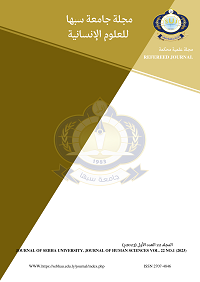
Du Lieu Émerge La Conscience
DOI:
https://doi.org/10.51984/johs.v22i1.2587Keywords:
place, ., identity,, spaceAbstract
This Le sujet de cette recherche choisi porte une réflexion sur la question de l’identité dans l'œuvre de Le Clézio. Au départ, je voulais étudier la symbolique du désert chez Ibrahim Al Koni, mais j’ai découvert que cette thématique avait déjà été largement abordée chez Le Clézio. J’ai donc porté ma réflexion sur les lieux en général, et les questions d’identité qui n'ont pas fait l'objet d'une étude systématique dans l'œuvre de l'auteur. Je suis parti de l’idée que la description du lieu révèle toujours une vision du monde, et j’ai cherché à saisir le sens que Le Clézio assigne aux lieux dans ses romans. J’ai constaté qu'il existe une dualité entre la ville, lieu d'aliénation et d'angoisse, et l'espace naturel. Les lieux décrits sont souvent inspirés par les événements violents du monde moderne, et l'écriture de Le Clézio est ancrée dans une réalité décevante. Je mets également en avant la présence des marges dans ses romans, qui portent la marque du monde civilisé et abritent les pauvres, les anonymes et les exclus. Enfin, la question de l’identité chez Le Clézio met en évidence l'usage récurrent des métaphores, des symboles et des mêmes thématiques d'un roman à l'autre. La description du lieu accorde une grande place à l'imaginaire, conduisant à une idéalisation de la nature, présentée comme un espace de bonheur, de liberté et d'ouverture vers l'altérité. Le Clézio rappelle ainsi que l'être humain est partie intégrante de la nature et cherche un bonheur authentique perdu à jamais pour le monde moderne.
Downloads
Downloads
Published
Issue
Section
License
Journal of Humanities Policy on Intellectual Property and Plagiarism
1. Commitment to Intellectual Property and Ethics
The Journal of Humanities (JOHS) is fully committed to respecting intellectual property rights and aims to protect the originality and authentic work of authors who submit their manuscripts for publication. The journal takes a firm stand against articles that contain any form of plagiarism and emphasizes the need for all researchers to adhere to the highest ethical standards in scientific research.
2. Anti-Plagiarism Policy
The journal considers plagiarism a serious violation of academic ethics. Therefore, authors must ensure that their work is original and not plagiarized, and that any use of external sources is properly cited and documented according to correct academic standards.
-
Actions Taken: In the event that any plagiarism or academic theft is discovered in a submitted article, the editorial board will contact the author to request a formal explanation within a maximum period of two weeks from the date of notification.
-
Investigation and Decision: After receiving the explanation, the article will be referred to the journal's specialized committees, which will investigate the matter and take the necessary measures, which may include the permanent rejection of the article and the imposition of disciplinary actions.
3. Publication License and Author Rights
The journal adopts the Creative Commons license type Attribution-NonCommercial-NoDerivs 4.0 International (CC BY-NC-ND 4.0), which allows for the following:
-
Attribution: Users are entitled to cite the content published in the journal and use it in their work, provided that the original source and author are clearly credited.
-
Non-Commercial: The published content may not be used for any commercial purpose.
-
NoDerivs: It is not permitted to make any modifications, distortions, or to build derivative works from the published content.
Under this license, authors are required to complete an exclusive license agreement for the journal. Authors retain the rights to their research data and may reuse and share their work for scientific purposes with proper citation.