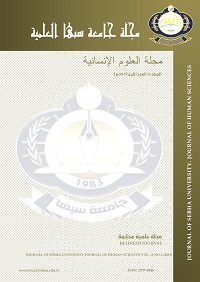
The legal nature of criminal liability for the possible outcome In Libyan law, Comparative study
Article Sidebar
Main Article Content
Abstract
This research discusses the legal implications upon the perpetrators of incompletely-shared crimes, where a perpetrator does not commit the crime as agreed with the partner, or he/she committed it in addition to another crime that is likely to be committed under the normal course of things by participating in the discussion that took place on the partner’s responsibility for the crime s/he commit with his/her partner. Unlike the crime that a partner planned to contribute in committing it, the legislator decided to hold that partner accountable for the second crime too, because justice requires that he/she does not escape the punishment on the pretext that s/he did not intend to commit the possible outcome of her/his act. But other views of justice argue: the perpetrator is only made accountable for what s/he committed or intended to participate in committing it. This issue necessitated researching to explore differences in determining this responsibility as prescribed in the Libyan and Egyptian laws. The aim is to understand the legislator’s intentions in determining the legal framework of responsibilities in shared crimes and to establish its legal stand in-line with Article (103.ق. ع. ل).
Downloads
Article Details
Journal of Humanities Policy on Intellectual Property and Plagiarism
1. Commitment to Intellectual Property and Ethics
The Journal of Humanities (JOHS) is fully committed to respecting intellectual property rights and aims to protect the originality and authentic work of authors who submit their manuscripts for publication. The journal takes a firm stand against articles that contain any form of plagiarism and emphasizes the need for all researchers to adhere to the highest ethical standards in scientific research.
2. Anti-Plagiarism Policy
The journal considers plagiarism a serious violation of academic ethics. Therefore, authors must ensure that their work is original and not plagiarized, and that any use of external sources is properly cited and documented according to correct academic standards.
-
Actions Taken: In the event that any plagiarism or academic theft is discovered in a submitted article, the editorial board will contact the author to request a formal explanation within a maximum period of two weeks from the date of notification.
-
Investigation and Decision: After receiving the explanation, the article will be referred to the journal's specialized committees, which will investigate the matter and take the necessary measures, which may include the permanent rejection of the article and the imposition of disciplinary actions.
3. Publication License and Author Rights
The journal adopts the Creative Commons license type Attribution-NonCommercial-NoDerivs 4.0 International (CC BY-NC-ND 4.0), which allows for the following:
-
Attribution: Users are entitled to cite the content published in the journal and use it in their work, provided that the original source and author are clearly credited.
-
Non-Commercial: The published content may not be used for any commercial purpose.
-
NoDerivs: It is not permitted to make any modifications, distortions, or to build derivative works from the published content.
Under this license, authors are required to complete an exclusive license agreement for the journal. Authors retain the rights to their research data and may reuse and share their work for scientific purposes with proper citation.