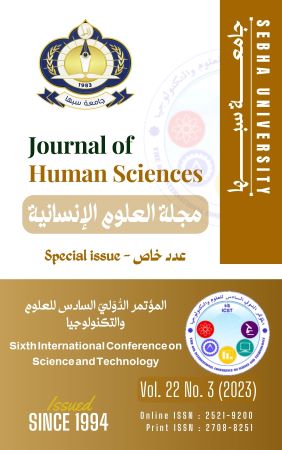
Obstacles to the use of educational technologies in teaching people with special needs from the point of view of female teachers in the city of Sebha *A field study
DOI:
https://doi.org/10.51984/johs.v22i3.2742Keywords:
Obstacles., Education technologies, People with special needsAbstract
The aim of the current research is to identify the "obstacles to the use of educational technologies for people with special needs from the point of view of female teachers in Sebha" attributable to some variables (type of disability - number of years of educational experience - number of training courses obtained in the field of educational technologies). And then using the questionnaire "Obstacles to educational technologies" prepared by the two researchers, and it includes (23) items distributed on (3) axes, and the research sample included (60) female teachers, and the study reached several results, which are the following: There are obstacles to the use of educational technologies for people with special needs From the point of view of female teachers in Sebha city, it also indicates the arithmetic mean of the questionnaire as a whole and of the axes. As for the study variables, there are no statistically significant differences in Obstacles to the use of educational technologies for people with special needs from the point of view of female teachers in Sebha, due to the variable (type of disability - years of educational experience). As for the variable "the number of training courses obtained in the field of educational technologies": (one-two-3 courses and more), there are statistically significant differences on the questionnaire as a whole, as for the axes, there are no statistically significant differences for the first axis, "obstacles of the master teacher" Using the teaching aids "according to (one-two-3 courses and more). From the point of view of parameters. While there are statistically significant differences on the second and third axis "goals of achieving the educational plan using educational technologies - obstacles for people with special needs using educational technologies". According to the variable number of training courses obtained in the field of educational techniques from the point of view of female teachers in Sebha, and it was in favor of the number of courses (3 courses and more).
Downloads
Downloads
Published
Issue
Section
Categories
License
Journal of Humanities Policy on Intellectual Property and Plagiarism
1. Commitment to Intellectual Property and Ethics
The Journal of Humanities (JOHS) is fully committed to respecting intellectual property rights and aims to protect the originality and authentic work of authors who submit their manuscripts for publication. The journal takes a firm stand against articles that contain any form of plagiarism and emphasizes the need for all researchers to adhere to the highest ethical standards in scientific research.
2. Anti-Plagiarism Policy
The journal considers plagiarism a serious violation of academic ethics. Therefore, authors must ensure that their work is original and not plagiarized, and that any use of external sources is properly cited and documented according to correct academic standards.
-
Actions Taken: In the event that any plagiarism or academic theft is discovered in a submitted article, the editorial board will contact the author to request a formal explanation within a maximum period of two weeks from the date of notification.
-
Investigation and Decision: After receiving the explanation, the article will be referred to the journal's specialized committees, which will investigate the matter and take the necessary measures, which may include the permanent rejection of the article and the imposition of disciplinary actions.
3. Publication License and Author Rights
The journal adopts the Creative Commons license type Attribution-NonCommercial-NoDerivs 4.0 International (CC BY-NC-ND 4.0), which allows for the following:
-
Attribution: Users are entitled to cite the content published in the journal and use it in their work, provided that the original source and author are clearly credited.
-
Non-Commercial: The published content may not be used for any commercial purpose.
-
NoDerivs: It is not permitted to make any modifications, distortions, or to build derivative works from the published content.
Under this license, authors are required to complete an exclusive license agreement for the journal. Authors retain the rights to their research data and may reuse and share their work for scientific purposes with proper citation.