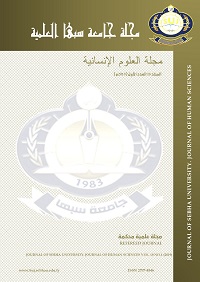
The role of social values in preventing crime A field study on a sample of students of the Faculties of the University of Sebha
DOI:
https://doi.org/10.51984/johs.v17i1.498Keywords:
values, prevention, crime, trends, sample.Abstract
The importance of studying social values ??and their role in preventing crime within communities are important topics that have received a lot of attention by researchers and those interested in examining humanities. The research dealt with the role of values ??in the prevention of crime among students of the faculties of medicine and arts at the University of Sabha. It is an applied descriptive and analytical study done through a sample, in order to identify the values ??that work to prevent crime. This is done by knowing the differences between the elements of the values ??defined in the research among the students of the two faculties. The results of this study contribute to the definition of values ??and their role in the prevention of crime in its five dimensions: the value of loyalty to the home country, the value of trust, the value of respect for the neighbor, the value of respect for public property, and the value of love of work. These values ??can be viewed as restrictions and controls regulating tendencies Selfish or aggressive impulses, as well as work to strengthen social cohesion. Values ??play a role in controlling behavior and prompt the individual to be consistent with the behavior of others. It reduces crime and delinquency in society, and contributes to inculcating active values ??in young people.
Downloads
Downloads
Published
Issue
Section
License
Journal of Humanities Policy on Intellectual Property and Plagiarism
1. Commitment to Intellectual Property and Ethics
The Journal of Humanities (JOHS) is fully committed to respecting intellectual property rights and aims to protect the originality and authentic work of authors who submit their manuscripts for publication. The journal takes a firm stand against articles that contain any form of plagiarism and emphasizes the need for all researchers to adhere to the highest ethical standards in scientific research.
2. Anti-Plagiarism Policy
The journal considers plagiarism a serious violation of academic ethics. Therefore, authors must ensure that their work is original and not plagiarized, and that any use of external sources is properly cited and documented according to correct academic standards.
-
Actions Taken: In the event that any plagiarism or academic theft is discovered in a submitted article, the editorial board will contact the author to request a formal explanation within a maximum period of two weeks from the date of notification.
-
Investigation and Decision: After receiving the explanation, the article will be referred to the journal's specialized committees, which will investigate the matter and take the necessary measures, which may include the permanent rejection of the article and the imposition of disciplinary actions.
3. Publication License and Author Rights
The journal adopts the Creative Commons license type Attribution-NonCommercial-NoDerivs 4.0 International (CC BY-NC-ND 4.0), which allows for the following:
-
Attribution: Users are entitled to cite the content published in the journal and use it in their work, provided that the original source and author are clearly credited.
-
Non-Commercial: The published content may not be used for any commercial purpose.
-
NoDerivs: It is not permitted to make any modifications, distortions, or to build derivative works from the published content.
Under this license, authors are required to complete an exclusive license agreement for the journal. Authors retain the rights to their research data and may reuse and share their work for scientific purposes with proper citation.