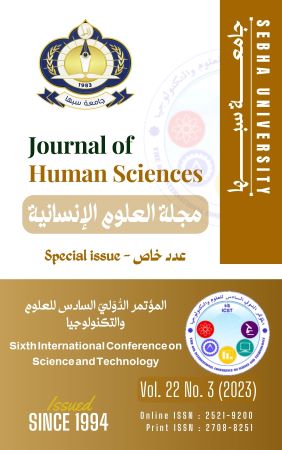
Computational linguistics between reality and hope. Sebha University as a model.
DOI:
https://doi.org/10.51984/johs.v22i3.2741Keywords:
Linguistics, Computer, Digitization, Curriculum, Sebha UniversityAbstract
In recent decades, linguistics has achieved a knowledge shift, represented by its theorists' awareness of the importance of the linguistic dimension in various fields, both human and applied. It was also represented in diagnosing problems related to applied linguistic studies, and trying to find knowledge solutions to them. Linguistic research methods have evolved as a result of changing linguistic views on the one hand, and the urgent knowledge needs of science, or the development of social needs that the world has witnessed in recent decades on the other hand, which are best represented by: technological developments, and the developments of artificial intelligence, about which views have become very intertwined today. Based on the foregoing, this paper aims to try to address the delay in research in computational linguistics, where the relationship between linguistics and the branches of natural sciences represented in: computer, that relationship that has become very important in the study of languages, including the Arabic language, will be dealt with. It has become one of the requirements for scientific progress in all branches of knowledge without exception, in addition to providing a great service to the Arabic language, especially in the field of machine translation. This will be done through two main points: the relationship between linguistics and computer science, and the reality of computational linguistics in Libyan universities, Sebha University as a model. As for the problematic of the study, it is represented in the following questions: How did the different methodological visions reflect on this scientific branch? What are the proposed solutions? What is the reality of computational linguistics in Libya? What are the desired prospects from this scientific branch? What is the impact of this on development?
Downloads
Downloads
Published
Issue
Section
Categories
License
Journal of Humanities Policy on Intellectual Property and Plagiarism
1. Commitment to Intellectual Property and Ethics
The Journal of Humanities (JOHS) is fully committed to respecting intellectual property rights and aims to protect the originality and authentic work of authors who submit their manuscripts for publication. The journal takes a firm stand against articles that contain any form of plagiarism and emphasizes the need for all researchers to adhere to the highest ethical standards in scientific research.
2. Anti-Plagiarism Policy
The journal considers plagiarism a serious violation of academic ethics. Therefore, authors must ensure that their work is original and not plagiarized, and that any use of external sources is properly cited and documented according to correct academic standards.
-
Actions Taken: In the event that any plagiarism or academic theft is discovered in a submitted article, the editorial board will contact the author to request a formal explanation within a maximum period of two weeks from the date of notification.
-
Investigation and Decision: After receiving the explanation, the article will be referred to the journal's specialized committees, which will investigate the matter and take the necessary measures, which may include the permanent rejection of the article and the imposition of disciplinary actions.
3. Publication License and Author Rights
The journal adopts the Creative Commons license type Attribution-NonCommercial-NoDerivs 4.0 International (CC BY-NC-ND 4.0), which allows for the following:
-
Attribution: Users are entitled to cite the content published in the journal and use it in their work, provided that the original source and author are clearly credited.
-
Non-Commercial: The published content may not be used for any commercial purpose.
-
NoDerivs: It is not permitted to make any modifications, distortions, or to build derivative works from the published content.
Under this license, authors are required to complete an exclusive license agreement for the journal. Authors retain the rights to their research data and may reuse and share their work for scientific purposes with proper citation.